Table of content

This one rep max calculator lets you estimate your maximum lifting capacity based on weight and reps. Whether you're training for strength or tracking progress, this 1RM calculator gives quick, reliable results for smarter workouts.
Getting your estimated 1RM takes just a few seconds. The tool is designed to be simple, so you can focus on your workout instead of figuring out complicated inputs.
You don’t need any extra setup or technical knowledge. Just enter your numbers and get your result right away.
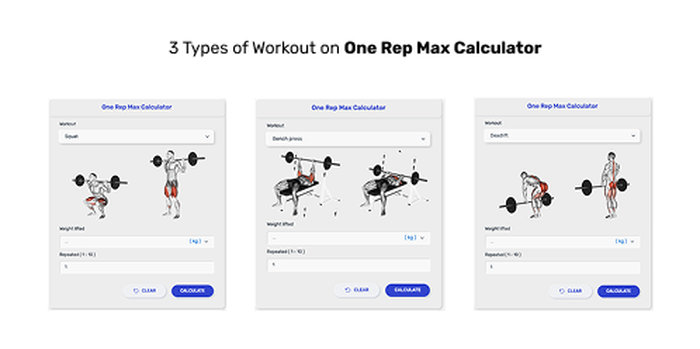
This one rep max calculator is built to cover the most common strength training needs, whether you're lifting casually or following a structured plan.
Estimate your 1RM from any rep range (best accuracy under 10 reps)
Work with major compound lifts like bench press, squat, and deadlift
Convert submax lifts into a clear strength benchmark
Support both kilograms and pounds for flexibility
Deliver instant results for quick workout adjustments
It’s not limited to one type of training. You can use this 1RM calculator to guide progression, compare performance, or simply get a better idea of your current strength level.
Your result shows an estimated one rep max, which is the maximum weight you could lift for one full repetition with solid form. It gives you a practical strength reference without needing to test an all-out max in the gym.
You can use this number to plan workouts, adjust training intensity, and track progress over time. Many lifters use their estimated 1RM to choose working weights for different goals.
For example:
Around 60–70% of your 1RM is often used for lighter volume work
Around 75–85% is common for strength-focused training
Around 90% and above is usually close to near-max effort
The result should be treated as a training estimate, not a fixed number. Your actual max can vary depending on sleep, recovery, exercise technique, and the lift you perform.
A one rep max calculator fits naturally into everyday training. You don’t need to be advanced to use it—it works just as well for beginners building a routine as it does for experienced lifters refining performance.
Planning workout intensity based on percentage training
Tracking strength progress over time
Avoiding risky max-out attempts in the gym
Adjusting weights during a training program
Preparing for strength-based goals or competitions
Many people use a 1RM calculator regularly as part of their weekly routine. Instead of guessing weights or pushing too hard too often, it gives a steady reference point to train more consistently.
Most versions of a one rep max calculator use a standard estimate formula based on the weight you lifted and the number of reps you completed. One of the most common options is the Epley formula:
1RM = weight × (1 + reps × 0.0333)
This means the calculator takes your working set and projects what your maximum single lift could be under normal conditions.
For example, if you lift 80 kg for 5 reps, the estimate would be:
1RM = 80 × (1 + 5 × 0.0333)
1RM = 80 × 1.1665
1RM ≈ 93.32 kg
This formula is usually most reliable when your reps stay in a lower range, especially around 1 to 10 reps. Once the rep count gets too high, the estimate becomes less precise because muscular endurance starts to affect the result more than pure strength.
Some tools may use a different 1RM calc formula, so you may notice small changes from one calculator to another. That is normal. The goal is not to get a perfectly exact number, but to get a strong training estimate you can use for planning weights, setting percentages, and tracking progress.

Once you have your one rep max, it becomes a practical reference for choosing the right weight in each workout. Instead of guessing or lifting randomly, you can base every set on a percentage of your 1RM.
Here’s a simple way to structure your training:
50–60% → light work, warm-up sets, or recovery sessions
65–75% → muscle-focused training with higher volume
80–90% → strength-focused sets with lower reps
90–100% → near-max effort, usually for testing or advanced lifting
For example, if your estimated 1RM is 100 kg:
70% → 70 kg for controlled sets
85% → 85 kg for strength work
This approach keeps your training consistent and progressive. As your 1RM increases over time, your working weights naturally increase with it, making it easier to track improvement without constantly testing your true max.
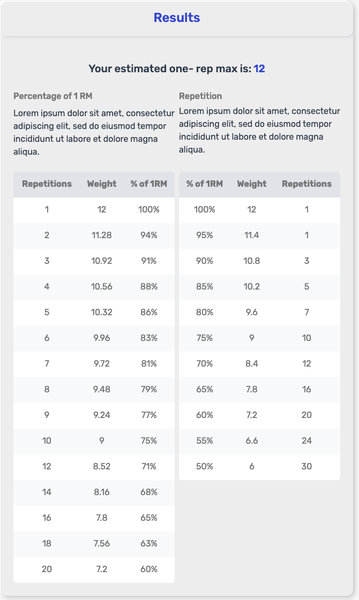
Testing a true one rep max requires more than just loading the bar. A proper setup, controlled warm-up, and correct timing between sets all play a role in getting an accurate result without unnecessary risk.
This example shows how a real 1RM test is structured in practice, from gradual weight increases to final attempts. Notice how each set builds toward the max instead of jumping straight into a heavy lift.
A key takeaway here is pacing. Most lifters perform best when they increase weight in small increments while keeping rest periods consistent. This approach gives a more reliable one rep max compared to rushed or uneven attempts.
💡 Do you know?
According to guidelines referenced by the National Strength and Conditioning Association (NSCA), proper rest between heavy sets can range from 3 to 5 minutes, which directly affects peak strength output.
Epley, B. (1985) – Poundage Chart
https://archive.org/details/NSCAJ1985
Brzycki, M. (1993) – Strength Testing—Predicting a One-Rep Max from Reps-to-Fatigue
https://journals.lww.com/nscajscr/abstract/1993/11000/strength_testing__predicting_a_one_rep_max_from.1.aspx
Lombardi, V.P. (1989) – Beginning Weight Training: The Safe and Effective Way
https://books.google.com/books/about/Beginning_Weight_Training.html?id=6yJtAAAACAAJ
Mayhew, J.L., Ball, T.E., Arnold, M.D., Bowen, J.C. (1992) – Relative Muscular Endurance Performance as a Predictor of Bench Press Strength in College Men and Women
https://journals.lww.com/nsca-jscr/abstract/1992/11000/relative_muscular_endurance_performance_as_a.2.aspx
Reynolds, J.M., Gordon, T.J., Robergs, R.A. (2006) – Prediction of One Repetition Maximum Strength From Multiple Repetition Maximum Testing and Anthropometry
https://pubmed.ncbi.nlm.nih.gov/16937972/
For most people, yes. A 1 rep max calculator is a safer and more practical option for regular training. Testing a true max can be useful in some cases, but it also puts more stress on the body and carries more risk.
Yes. This 1RM calculator works well for major strength lifts such as bench press, squat, deadlift, overhead press, and similar exercises where you track weight and reps.
Lower rep ranges usually give better results. Most lifters get the most useful estimate when they use a set between 3 and 8 reps. Very high rep sets are less reliable for a 1RM calc.
Every few weeks is enough for most people. You do not need to calculate it after every session. Checking it regularly but not too often gives you a better view of long-term progress.
Yes. If you calculate your one rep max after a very tiring workout, the estimate may come out lower than expected. For a more useful number, use a solid working set when you feel reasonably fresh.
You can, but the estimate may be a little less consistent than barbell lifts. Dumbbell exercises often depend more on balance and control, which can affect the result.
Training works better when progress is easier to measure. one-rep-max-calculator.com was created to help lifters, athletes, coaches, and fitness enthusiasts estimate strength levels quickly and conveniently based on weight and repetitions performed. Whether you're planning workouts, tracking progress, or setting realistic training goals, this tool is designed to make strength calculations more accessible and easier to understand.
This tool was developed by the one-rep-max-calculator.com team, with contributions from developers, fitness-focused content creators, and digital tool specialists committed to building practical calculators that support smarter training and better decision-making. Our goal is to turn useful performance data into a simple, user-friendly experience that helps people train with more clarity and confidence.
We aim to keep this tool practical, transparent, and easy to rely on.
one-rep-max-calculator.com does not require accounts or personal details. The workout values you enter (such as weight and reps) are used only to generate results and are not stored or shared.
This tool provides estimated one-rep max values based on commonly used formulas. Results can vary depending on factors like training experience, form, fatigue, and individual physiology. Always use judgment and avoid treating estimates as exact limits.
This calculator is intended for general fitness planning and progress tracking. It is not a substitute for professional coaching, medical advice, or proper supervision—especially when lifting heavy weights. Prioritize safety and proper technique at all times.
We may refine this tool and update this Policy over time. Any changes will be posted here to keep everything clear, accurate, and up to date.